Thinking
What means “white”?
White is an electromagnetic property of an object.
So if you have no additional information about the object, you can only say that it is white, nothing else.
If you are in a porcelain shop, most of the objects you recognize as white are porcelain. But what about an object of 21 cm by 29.7 cm size?
That is the point where a geologist would take his hammer and “test” it. But in a paper shop he may not.
Additional Information
What we need if we are using a method like “remote sensing” (like MT, where we can’t touch the objects) is additional information.
- geological history / orogeny
- geological setting / location (e.g. sedimentary basin, volcanic area, etc.)
- additional geophysical data (e.g. seismic, gravity, etc.)
So in Northern Germany a resistive blob is likely a salt dome, while in the Alps it is likely a granite intrusion.
The location we obtain from standard maps.
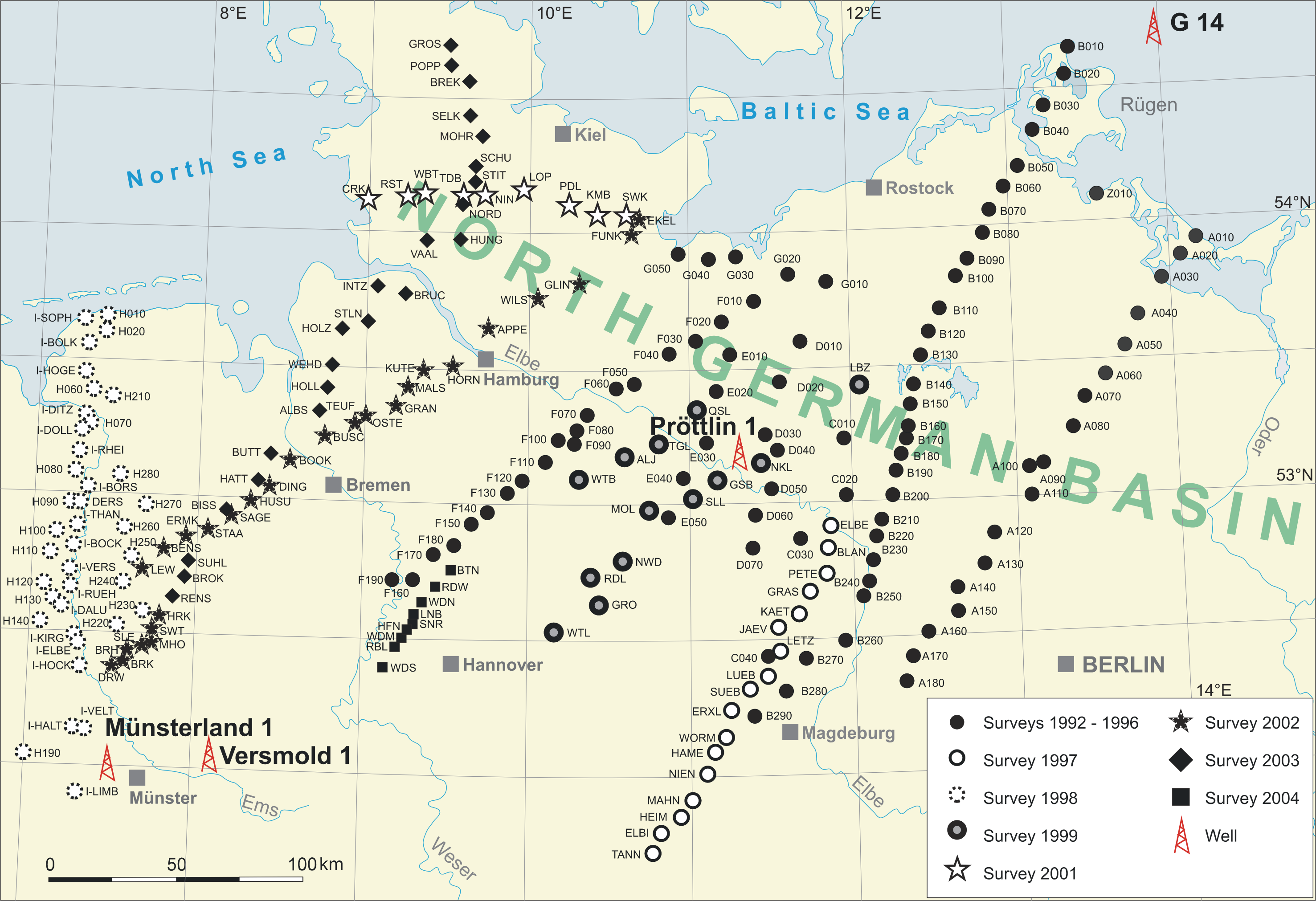
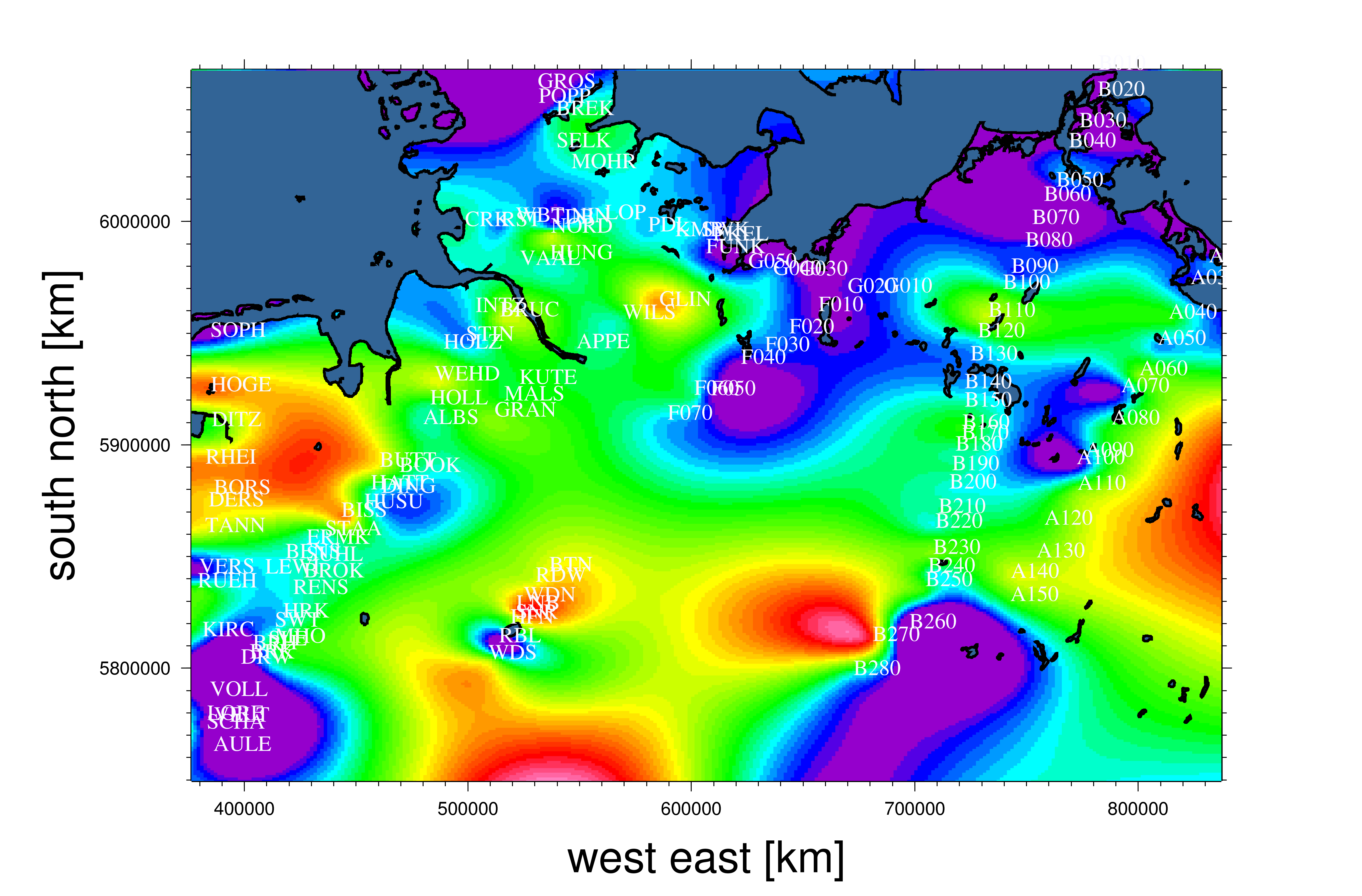
After our MT measurements we can plot the resistivity distribution onto the map and see where the resistive and conductive areas are.
This is the point where we can start to interpret the data.
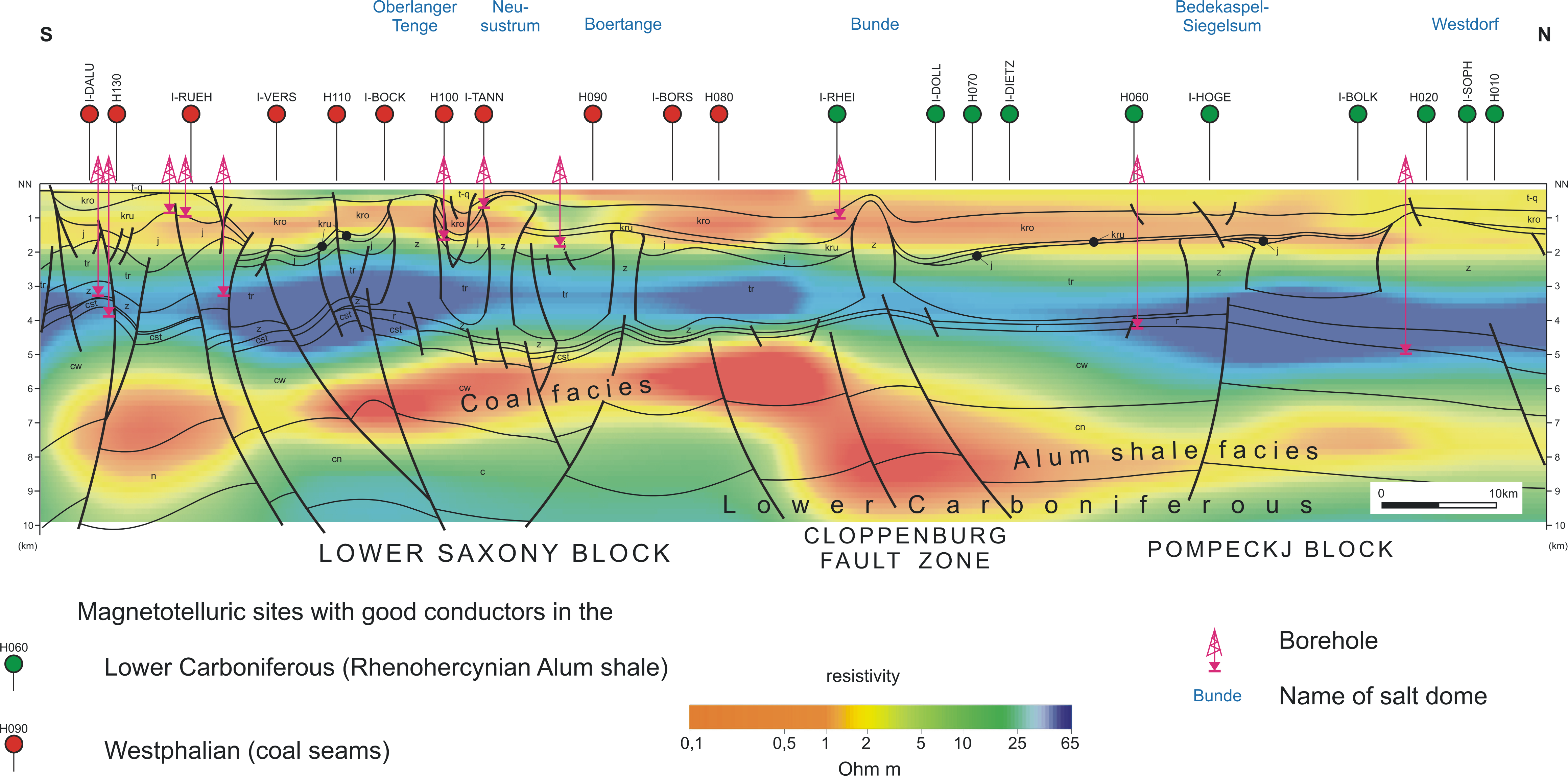
With the estimated ideas of the geology we now synchronize the geological and geophysical data.
Magic Maxwell
The Maxwell equations are the fundamental equations of electromagnetism.
In the 1860s, Maxwell found out that changing electric fields can create magnetic fields and vice versa. In the case of MT the magnetic field is traveling through the non-conductive air into to the conductive ground. Depending on the conductivity of the ground, the magnetic field will induce electric currents, which in turn generate secondary magnetic fields (which we measure with our induction coils on the surface). We additionally measure the electric field at the surface as well (with the electrodes).
Keep in mind that we measure waves or wave fields, which are frequency dependent.
Apparent resistivity
Apparent means, that we we do need directly measure the resistivity like in a lab, but we calculate rho_a and it “appears” like a resistivity.
\[\rho_a(\omega) ~ \frac{E(\omega)}{H(\omega)}\] Where ω is the angular frequency, E is the electric field and H is the magnetic field.
The apparent resistivity is a function of frequency, and it is a complex number.
Skin depth
Simply spoken, this phenomenon describes that the penetration depth of the electromagnetic field into the ground is frequency dependent.
The higher the frequency, the shallower the penetration depth, and vice versa, with lower frequencies (aka greater periods) the penetration is deeper. So we know, that E/H @4096Hz is “above” E/H @2Hz.
You know this phenomenon from your normal life. When you approach a noise source (teens: discotheque), you first hear the low frequencies (bass, long periods, long / deep penetration) and then the high frequencies (treble, short periods, high frequencies).
What happens now is, that we make many ratios of E/H over many frequencies (from high to low, aka top to bottom) and we get a profile of apparent resistivity with depth.
Resolved
Unfortunately we get the “integrated resistivity” (or “integrated conductivity”), so thickness * conductance.
So you say: I traveled for one hour. … but what was the distance?
Same problem: km/h or S/m.