flowchart TD
subgraph "ADU"
    A[ADU-10e]
    B[ADU-11e]
end
subgraph "Sensors"
    C[FGS-04e]
    D[[MFS-06e]]
    E[[MFS-12e]]
    F[[MFS-07e]]
    G[SHFT-03e]
    H[SHFT-02e]
end
A --> C
A ==> D
A --> E
B ==> D
B ==> E
B ==> F
B --> G
B --> H
subgraph "Methods"
    I["LMT"]
    J[["MT"]]
    K[["AMT"]]
    L["RMT"]
end
C --> I
D --> I
D ==> J
E ==> J
E --> K
F ==> J
F ==> K
G --> K
H --> K
H --> L
Sensors
Functionality
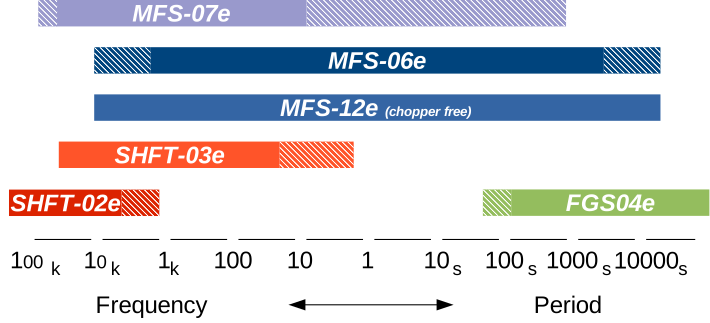
Each sensor has a frequency range where the sensor is most sensitive. There is not “interrupt” at the boundary but a slight transition where a different sensor performs better.
SHFT-02e
A classic RMT sensor with a frequency range from 1 kHz to 250 kHz.
The casing can be stripped off and sensors can be integrated into an airborne system.
Assuming a speed of 10 m/s a sampling rate of 16 to 64 kHz is suitable.
SHFT-03e
A classic AMT sensor with a frequency range from 1 Hz to 64 kHz.
The 1 Hz sensitivity is suitable for CSAMT.
The casing can be stripped off and sensors can be integrated into an airborne system.
If you use a so called “semi airborne” configuration like in the DESMEX project, the sensor can be used for depths down to approximately 2 km depth.
MFS-07e
The MFS-07e is a classic AMT/MT sensor with a frequency range from 1 s to 50 kHz, but still delivers data down to 1000 s.
Most commercial exploration projects use periods down to 10 or 100 s and get 1 - 5 km depth. for this purpose the MFS-07e is excellent.
Especially when your surface resistance and upper layers are assumed to be above 200 \(\Omega\)m, you reach your desired depth range easily.
MFS-06e
The MFS-06e is a classic MT sensor with a frequency range from 10 kHz to 10,000 s.
The sensor is used for depths down to 10 km and more.
Opposite to the MFS-07e the MFS-06e is used where you are working in conductive areas with surface resistances below 200 \(\Omega\)m, like in the Northern German Basin, where we have a resistance of 2 - 20 \(\Omega\)m
It is one of the most used sensors for scientific purposes.
MFS-12e
Chopper free sensor with a frequency range from 10,000 s to 20 kHz.
This unleashes the full its full potential together with the ADU-11e. You can measure MT and AMT simultaneously. That is what in most cases is what you desire. This is the sensor for commercial projects and typical depths of 5 km and more.
FGS-04e
The FGS-04e is a classic LMT sensor with a frequency range from DC up to 100 s.
At periods around 100 s you are already in a depth range of 5 - 10 km. This can be easily covered with induction coils.
You should only consider the FGS-04e when your interest is in the deep structures: 10 - 200 km depth.
Compared to the MFS-06e the FGS-04e is equal and better below 1000 s.
Ranges
| Sensor | f max | f opt max | f opt min | f min |
|---|---|---|---|---|
| SHFT-02e | 250 kHz | 250 kHz | 5 kHz | 1 kHz (CSAMT) |
| SHFT-03e | 64 kHz | 64 kHz | 1 kHz | 1 Hz (CSAMT) |
| MFS-07e | 50 kHz | 40 kHz | 1 s | 1000 s |
| MFS-12e | 20 kHz | 20 kHz | 1000 s | 10,000 s |
| MFS-06e | 10 kHz | 1 kHz | 4096 s | 10,000 s |
| FGS-04e | 30 s | 100 s | 40,000 s | DC |
Can I measure 50,000 or 100,000 s with a coil?
I am tiered of this question.
The answer is: No, you cannot.
The output voltage of a coil is proportional to the change of the magnetic field.
\[ V \sim \frac{B}{dt} \] and this becomes zero at long periods > 10,000 s.
Additionally even “chopper stabilized” amplifiers can not completely eliminate the 1/f noise at these long periods.
\[ V_n \sim \frac{1}{f} \] so \[ V_{total} = V + V_n \rightarrow V_n(T>10,000s) \] All manufactures can present the “lucky shot” of a measurement at 50,000 s or more, but this is not reproducible.
Similarly this applies to AMT shots measured close to equatorial regions.
And what about the super RR formula for LF? yes, that is what you already for getting the ~ 10,000s.
If you are and expert and have a PhD: you choose a fluxgate for periods > 10000 s.
Typical Configurations
You can treat an ADU-07e and ADU-08e as well as ADU-12e as ADU-10e + ADU-11e “in one box”.
The separate configuration gives you a much greater flexibility in the field.
The greatest burden of the acquisition is borne by the MFS-XXe sensors.