32 or 24 bit
First of all: as more bits you have for digitalization, as more precise the signal is. But there are some things you need to know.
Heisenberg uncertainty principle
The Heisenberg uncertainty principle states that the more precisely the position of a particle is determined, the less precisely its momentum can be known, and vice versa. This principle applies to all measurements, including digital recordings.
Simply spoken, as higher the sampling rate is, as less time the ADC has to convert the analog signal into a digital value. Today (2025) we see that we have 32 bits up to 8 (or 24) kHz, 24 bits up to 1 MHz and 16 (or 8) bits up to 10 MHz and above.
Effective Number of Bits (ENOB)
Some factors decrease the “effective number of bits” (ENOB) of a digital recording. These factors are:
- Insufficient charge settling time in SAR or Delta-Sigma ADCs.
- Thermal and quantization noise overpowering the least significant bits.
- Clock jitter effects causing slight timing variations in each sample.
- Bandwidth restrictions preventing full signal reconstruction.
Least Significant Bit (LSB)
The least significant bit (LSB) is the smallest value that can be represented by a digital system. It is the rightmost bit in a binary number and represents the smallest increment in value. The LSB is crucial for determining the resolution of a digital recording.
But as seen above, the least value is maybe not there or not usable.
ENOB and LSB are used in the common practice to determine the usable range; for a 32 bit ADC you may have 30 or 28 bits or less usable. If at the high end (the maximum value) the system input is not linear or the electric circuit is at his edge, maybe even “bit number 32” is not usable; but the later problem is easy to handle1
ADC Resolution
a typical ADC has a resolution of ±(2n-1) steps, where n is the number of bits. For example
- 24-bit ADC can represent values from −8,388,608 to +8,388,607
- 32-bit ADC from −2,147,483,648 to +2,147,483,647
Assuming ± 2.5 V input range, the resolution for the complete 5 V range is2: * 24-bit ADC: 5 V / (224 - 1) = 5 V / 16,777,215 ≈ 0.298 μV ≈ 300 nV * 32-bit ADC: 5 V / (232 - 1) = 5 V / 4,294,967,295 ≈ 1.16 nV
- Thermal Noise: At room temperature (approximately 300 K), even a 1 kΩ resistor generates thermal noise \(\approx 4\ \mathrm{nV}/\sqrt{\mathrm{Hz}}\) This is already several times larger than the LSB.
- \(1/f\): This dominates at low frequencies like 1 Hz and can be much larger than the ADC’s smallest step.
- Sensor Noise: Also the coils have intrinsic noise exceeding 1.16 nV; for example the current noise caused by the windings.
- Op-Amp Noise: Even the best ultra-low-noise op-amps, such as the OPA1611 or LT1028, have input-referred voltage noise levels of \(1 \to 3\,\mathrm{nV}/\sqrt{\mathrm{Hz}}\)—already close to the ADC resolution. In practice, real-world noise will likely mask the benefits of a 32-bit ADC.
What Remains?
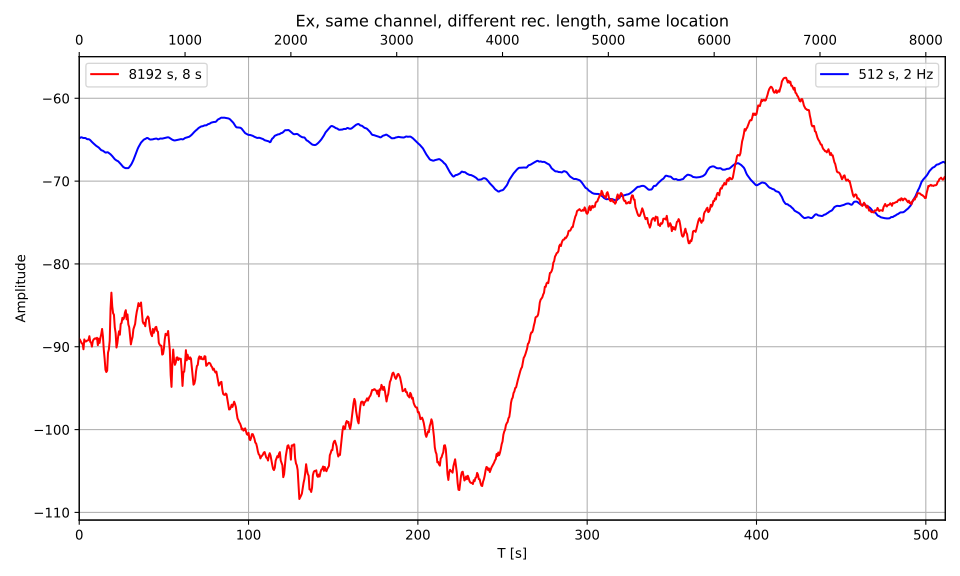
Well, the real benefit of a 32-bit ADC is the dynamic range, which you need for the D R I F T of your electrodes or for long fluxgate measurements.
Together with the extremely low power consumption of the ADU-10e, the 32-bit resolution of this instrument is perfect for long-term measurements for weeks.
The ADU-11e can be tuned with its pre-amplifier (say factor 4) to get the same outstanding resolution. You can shorten the E-Field lines in case. Under most conditions (3 - 5 days recording time) you will not see a difference between the 32-bit and the 24-bit resolution.
So the final answer is: only in some geological settings you may wish to use the 32-bit resolution.
Footnotes
When testing a digital audio recording on a valuable HiFi system, you listen to the very silent passages, where the LSB is important. For the amplifier as well the speaker finally it is very difficult to replicate the little steps between very silent and a little bit less silent, to amplify and have an output of 1.1 Watts or 1.2 Watts. That has almost no tolerance. On the other hand, making steps between 110 Watts and 120 Watts (loud and very loud) is easy to handle. A tolerance of 0.1 Watts at this output is negligible.
↩︎Some use instead of n - 1 just n. That depends how you define the range and how to treat the zero point. With 24 bits and above it is more of an academic nature.
↩︎