Testing
Preface
Most of the tests are done in the field. The noise level inside your laboratory or backyard of your institute is too high. The intrusion into system, cables and sensors will lead to wrong results.
On the other hand, you do not need a “quite” place to do the tests (where you would like to make MT recordings). A reasonable place outside the city will do1.
Electrodes
At the very end of all tests, you may decide to buy fresh electrodes!
The default lifetime is estimated to be 2 years.
Like freshly baked bread, electrodes age after production even not used (the bread also ages even if you don’t eat it).
Unreel the wires completely.
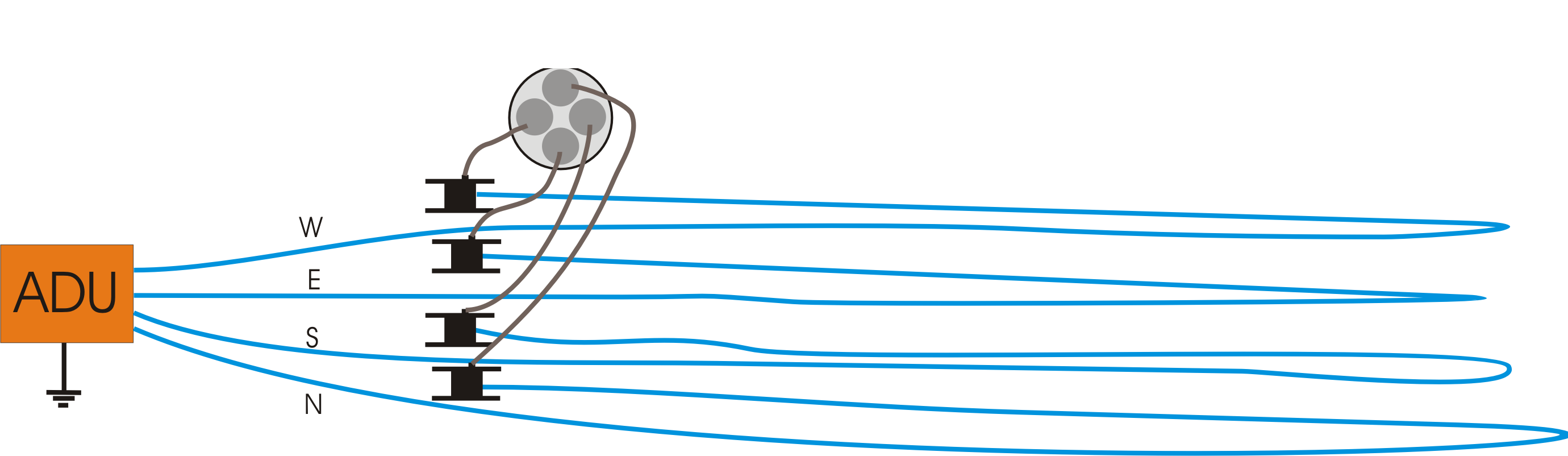
- Lay out your e-field cables in a way that all cable drums are placed on a location maybe 10 m away from the ADU. The other ends you connect to the ADU.
- Ground the ADU as usual.
- Use jumper cables to shorten the N/S and E/W cable drums, do not connect the electrodes.
- Select a gain of 4 for the first stage.
- Make a sounding of maybe 10 minutes with a sampling frequency of 256 Hz. Evaluate the background noise. It will be in the range of less than 100nV/sqrt(Hz). 50/60Hz peaks may be higher. Concentrate on the noise floor.
- Next step is to dig a hole for 4 electrodes. All electrodes to be tested shall be in the same pit and close together as shown in the picture. Connect them to the cable drums. Add water, etc. as you do usually.
- Repeat the sounding with the same settings, electrodes connected now.
- Evaluate the time series and spectra as done before with the shorted inputs. If the electrodes are ok, there should not be a much higher noise floor or jumps in the timeseries or high offset compared to first measurement. In other case the electrodes need to be replaced by new ones.
- Like mentioned in other articles: the loss of data is not comparable to the price of fresh electrodes
Parallel Sensor Test (PST)
The PST is a test to check that the sensors are working properly.
You simply compare the spectra of the sensors with each other. In case you use more than one system, make sure that all data is recorded simultaneously.
- burry the sensors 20 cm deep in the ground
- all sensors in the same direction, no matter which direction
- unreel the cables completely (20 m or what you have)
Hence that H is varying. So “as longer as better” does not apply here (E/H is constant).
| Sampling Rate | Recording Time | Remarks |
|---|---|---|
| 131 kHz | 32 s | you may see the coil limit |
| 32 kHz | (32 s) | done by 4x filter |
| 8 kHz | 2 m 8 s | |
| 2 kHz | (2 m 8 s) | done by 4x filter |
| 512 Hz | (2 m 8 s) | done by 4x filter, needed for overlapping chopper on /off older coils |
| 512 Hz | 2 m 8 s | recommended also for new switch free coils2 |
| — | — | normal PST stops here |
| 512 Hz | 17 m 30 s | only if you want to see lower frequencies |
| 128 Hz | (17 m 30 s) | done by 4x filter |
| 32 Hz | (17 m 30 s) | done by 4x filter |
| 8 Hz | (17 m 30 s) | done by 4x filter |
| 2 Hz | (17 m 30 s) | done by 4x filter |
(17 minutes and 4 seconds are 1024 seconds. But we want to filter with 4x so we take 17 m 30 s = 1050 s, each filtering is causing a loss of 1 second at least.)
You can compare only spectra with the same bandwidth. Down to 512 Hz the FFT should be of same length as the sampling rate.